Don’t Put All Your Eggs in One Basket: The Importance of Having a Photography Plan
One of the most valuable lessons I learned when I first started photography was never to rely on a single plan. Landscape photography, in particular, is heavily influenced by factors outside our control. No matter how much research you do, the weather, light, tides, water levels, and cloud formations can change in an instant.
In my early days, I would spend hours planning a single location. I would study weather forecasts, cloud cover, sunrise and sunset times, tide movements, and even the likely position of the sun. Everything would revolve around capturing one specific image. The problem was that if conditions didn't match my expectations, the entire trip could feel like a disappointment.
Today, my approach is very different. Whenever I head out with my camera, I plan multiple locations and alternative subjects. Having several options available means I can adapt to changing conditions and still come home with photographs I'm proud of.
A Real-World Example
Recently, I planned a sunrise photography trip to Swirral Edge in the Lake District. My research suggested there was a strong possibility of an inversion cloud forming at sunrise, creating spectacular conditions above the valleys. To capture this, I arranged my schedule to allow for a two-hour hike from the car park to reach the location before first light.
Unfortunately, photography doesn't always follow the script.
When I arrived, heavy rain was falling and the conditions were completely unsuitable for the inversion cloud I had hoped to photograph. The original plan was no longer viable.
Rather than giving up, I moved to Plan B.
Plan B – Waterhead, Lake Windermere
My first alternative was Waterhead on Lake Windermere. The idea was to photograph the sailing boats against the early morning light. However, upon arrival, I quickly realised the wind direction wasn't favourable. The boats were positioned poorly, and the composition simply wasn't working.
Time for Plan C.
Plan C – Keswick Cattle Gate
Next, I headed towards Keswick to photograph the well-known cattle gate standing in the water. Under normal conditions, it can create a striking foreground subject.
Unfortunately, the recent weather had left water levels much lower than expected, and the scene lacked the visual impact I was looking for.
Another plan had to be abandoned.
Plan D – Ashness Jetty
Thankfully, I had one final option.
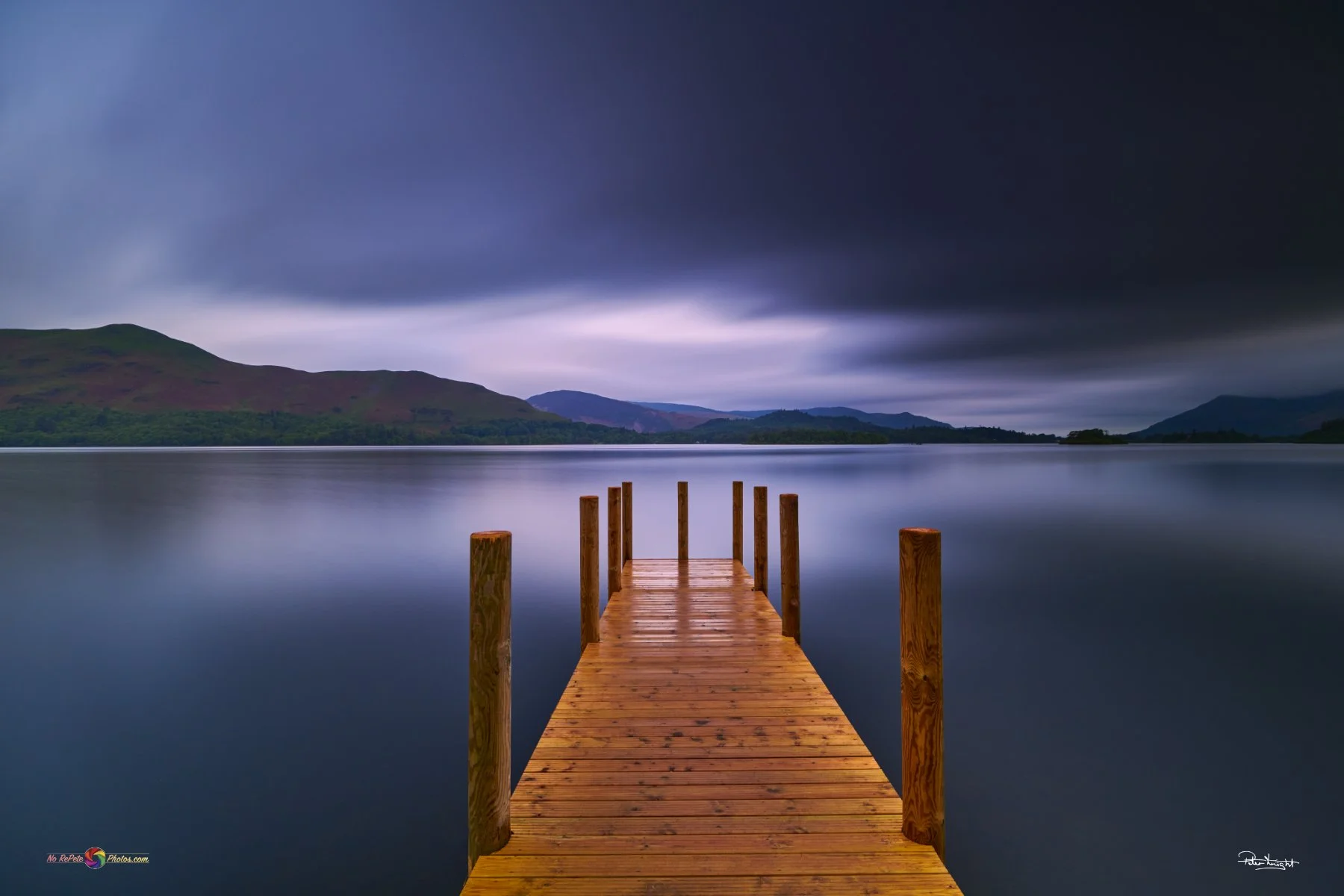
I drove to Ashness Jetty on Derwentwater. The jetty had recently been repaired, and the fresh timber immediately caught my attention. Combined with the dark, moody skies overhead, the scene offered a completely different photographic opportunity.
Rather than chasing dramatic sunrise colours, I decided to embrace the atmospheric conditions. Using a long exposure of approximately eight minutes, I smoothed the movement of the water and created a calm, minimalist image that contrasted beautifully with the textured wooden jetty and brooding sky.
The result was a photograph I had never originally planned to capture, yet it became the highlight of the trip.
Looking Beyond the Obvious
At Ashness Jetty, I also experimented with different camera heights and perspectives.
One image was captured from a higher viewpoint, emphasising the length and structure of the jetty. The second was taken from approximately half that height, creating a stronger connection between the leading lines and the water.
The other composition required more post-processing work because the surrounding hills intersected awkwardly with the jetty poles, creating visual distractions. Careful editing allowed these distractions to be reduced, resulting in a cleaner final image.
This experience reinforced another important lesson: even when you find a location that works, don't settle for a single composition. Explore different angles, heights, focal lengths, and perspectives. Sometimes a small change in camera position can completely transform an image.
The Lesson
Photography is often about adapting rather than controlling. We can research, plan, and prepare, but nature ultimately decides what conditions we are given.
By creating multiple backup plans, you dramatically increase your chances of success. More importantly, you open yourself up to opportunities that may never have been part of your original vision.
Some of my favourite photographs have come from abandoned plans, unexpected weather, and locations that were only intended as backups.